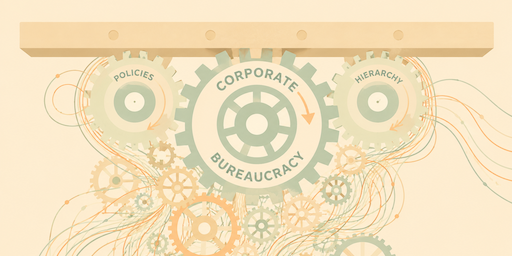
Built to align, not to imagine
Strategy development is one of the most expensive rituals in business. Depending on the pace of industry change, organisations convene every three to five years to do what feels like a thorough rethink. In fast-moving consumer goods the cycle might run every three years; in industrial manufacturing it can stretch to five or more. Either way, the same senior leaders tend to convene, apply the same analytical frameworks, and emerge with strategies that differ only marginally from the last time. The process feels rigorous; the output rarely justifies the effort.
The reason is structural. Traditional strategy development is designed to produce alignment, and alignment pushed far enough produces stasis. When an organisation’s operating model, business model, and management thinking are calibrated to the same set of assumptions, there is no room for the uncomfortable idea, the dissonant voice, or the signal that does not fit the dominant narrative. Strategy that begins as a creative act becomes, over time, a linear exercise in defending what already exists.
What the closed room cannot see
The executives who design strategy are, almost by definition, the people who are the most invested in the current model. They have built their careers on the assumptions that now need questioning and carry personal and professional equity tied to a view of the world that may have passed its expiry date. This is not a character flaw; it is a structural one. When strategy development is the exclusive domain of a small senior group, the organisation’s capacity to learn is limited by that group’s willingness to unlearn.
The signals that matter most travel poorly up organisational hierarchies. Emerging customer frustrations, competitive shifts at the edge of the market, new operating realities on the ground: by the time these reach a strategy session, they have been smoothed, filtered, and made palatable. Front-line employees often see problems before they become trends. Regional teams understand market nuances that aggregate data routinely misses. The people closest to the work frequently have the clearest view of what is not working and what could be different.
What inclusive strategy means
Inclusive strategy is not simply a correction to traditional strategy development. It is a fundamental different way to make strategy, one designed to capture a broader range of inputs, surface assumptions that would otherwise go untested, and build genuine ownership before implementation begins. The aim is not participation for its own sake; it is getting better answers to difficult questions.
Two levers drive this approach.
Underrepresented voices
Early career
Junior employees
Their equity is invested in the future rather than the past. They tend to see opportunities that experienced leaders have learned to discount.
geographic periphery
Closer to market reality
They carry a different picture of change than those at headquarters. Aggregate data routinely misses what they see on the ground.
cross-industry
Free from orthodoxy
People from other industries bring a freedom from orthodoxy that those raised within an industry rarely have.
The case for inclusion does not stop at the organisation’s boundaries. Customers, suppliers, and ecosystem partners frequently hold perspectives that internal participants cannot replicate, and where the strategic question touches their domain, bringing them in changes what the organisation is able to see.
Inclusive strategy is not strategy by committee. Decision rights remain with the leadership team throughout. What changes is the role senior leaders play: shifting from sole creators of strategy to editors who synthesise the best thinking from across the organisation rather than generating it in isolation. The quality of their decisions improves because the inputs are richer and the assumptions are tested, and execution improves because the people delivering the strategy already understand its logic.
How inclusive strategy changes the process
The Strategic Architecture Process we use with clients is built directly on the diagnosis above. Each of its four principles is a response to a specific failure mode of the closed-door approach.
01
Open the room
Strategy development involves participants selected for the diversity of their perspective rather than the seniority of their title. This breaks the cycle of the same people discussing the same issues and surfaces insights that would never reach a closed-door session.
02
Raise the ambition
Most large organisations are resource-rich but ambition-poor. Working Future Back from a vivid and specific picture of the future, the organisation wants to lead, providing the stretch that defending the present cannot.
03
Demand explicit choices
Inclusive strategy should sharpen decisions, not defer them: what to stop, what to start, and what to reallocate. A strategy that hedges everything satisfies no one and commits nothing.
04
Diverge then converge
Participation widens during discovery and option generation, tightens at the point of commitment, and widens again during rollout and learning. Without this discipline, inclusive strategy becomes open-ended consultation.
The rhythm
Navigating the real challenges
Inclusive strategy is worth pursuing even though it is harder than the closed-door alternative. Leaders who pursue it should expect five structural tensions and plan for them from the outset.
speed vs depth of input
Not all strategic information can be shared widely. Setting boundaries upfront, clearly and with rationale, protects both the process and the trust of participants.
Not every employee wants to contribute to strategy. Participation should be accessible rather than compulsory, and honest about the time and effort it asks of contributors.
Once stakeholders are included in one part of the process, expectations for broader access can escalate. Managing this requires upfront clarity about where the boundaries are and why they exist.
These tensions are manageable, but they are real. Organisations that treat inclusive strategy as a simple exercise in participation, without designing for these tensions, reliably produce the worst of both worlds: a slow process and a strategy no one owns.
AI as a practical enabler for inclusive strategy
One shift that has made inclusive strategy more viable at scale is the integration of AI into the process. The historical bottleneck was attentional: leadership teams could not synthesise thousands of inputs without significant delay or distortion, which placed a practical ceiling on how many voices could meaningfully contribute.
AI can now scan, cluster, and interpret large volumes of unstructured input in real time, surfacing weak signals, flagging outlier perspectives, and making synthesis tractable at a scale that was previously impractical. The constraint has shifted from processing input to designing a process worth contributing to.
What organisations that get inclusive strategy right end up with
Inclusive strategy, done well, produces a different quality of outcome. Decisions are better because the inputs are richer and the assumptions are tested before commitment rather than discovered during delivery. Execution is faster because alignment is built into the process rather than sold after the fact. And the organisation develops a capability, not just a strategy, for making sense of the world and choosing a direction together.
The organisations that will lead their markets in the next decade are the ones that figured out how to tap what their people already know and built a repeatable process for turning that collective intelligence into decisions, commitments, and action.
The discomfort of genuine inclusion, including the coordination cost, the exposure of assumptions, and the obligation to explain your reasoning, is not a flaw in the process; it is the point. Strategy made behind closed doors is not more rigorous; it is just more comfortable.
Further reading
Strategic Intent – Gary Hamel, Harvard Business Review
Strategy as revolution – Gary Hamel, Harvard Business Review
Innovation to the Core – Strategos