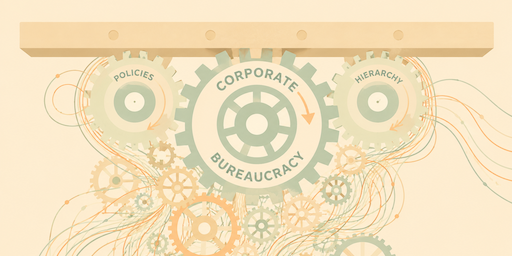
Most of your organisation’s productivity problems are not what they appear. The standard prescriptions, flatter structures, leaner processes, smarter automation, are producing diminishing returns at the very companies that have applied them most diligently. The problem is not execution. It is that you are pressing the accelerator on a process designed for a world that no longer exists.
This is the ceiling that many COOs are hitting in 2026. Two-thirds of leaders say their organisations are overly complex, with cross-functional processes consuming between 40 and 65 percent of management time. Sixty-one percent expect operating costs to climb again this year. The remedies that worked between 2010 and 2020, cost cuts, reorganisations, hierarchy flattening, Lean and Six Sigma rollouts, are reaching the point where pushing harder makes the organisation slower, not faster. What these organisations need is not better optimisation. They need business process redesign.
The remedy that built the ceiling
Continuous improvement, Lean, Six Sigma, and most enterprise efficiency programmes share an assumption that no one names out loud. They take the underlying design of the current process as a given. They ask how to remove waste from it, how to streamline it, how to automate it. But they never ask whether it should exist in its current form at all.
Gary Hamel, one of the founders of Strategos, called these underlying design rules management orthodoxies. He made the point that matters here: they are often so deeply ingrained in executive thinking that they are nearly invisible to the people running the process. The people closest to the work are the least likely to see them. That is why teams keep solving the wrong problem at higher and higher cost.
When the design itself is the problem, every tactical improvement runs into the same ceiling. You can take three days out of a 21-week process by tightening hand-offs. You cannot take 21 weeks down to four days without questioning the assumptions on which the process was built in the first place. And the cost of leaving those assumptions unexamined is not just slower cycles. Hamel and Michele Zanini have estimated that bureaucracy, the visible residue of unexamined management orthodoxies, costs US corporations roughly $3 trillion a year, about 17 percent of GDP. Worldwide, only one in eight employees is actively engaged at work. These are not morale problems. They are design problems.
This is also why AI applied to existing processes is producing such uneven returns. Business process redesign should precede AI deployment, not follow it.
Automating a process built on obsolete principles locks the dysfunction in at higher speed. You end up with a faster broken thing, and now you have invested in its infrastructure.
A different question
A different approach starts with a different question. Instead of asking how to improve the current process, ask: what would we have to believe is true to be running this process the way we run it today?
Every process is built on a set of implicit principles about who the customer is, what they need, how work flows, how decisions get made, who calls the close. Most of those principles were correct when the process was designed. Many are now obsolete.
We call this approach principles-based business process redesign. It differs from continuous improvement in one specific way: continuous improvement asks how to optimise the current design. Principles-based process redesign asks what the design should be and then works backwards. The work has four lenses: surface what stakeholders actually need to get the job done and explore how they use workarounds for the current operating procedures; look outside your organisation for similar operations running on different principles; name the current orthodoxies and test them against the future; and identify what has changed in the world that breaks the design you have today.
When Apple built the Genius Bar, it did not optimise the call centre. It overturned the implicit design rules of customer service that support should be remote, on-demand, menu-driven, and treated as a cost. It rebuilt the function on opposite principles: in person, scheduled, expert-led, and treated as a relationship. The Genius Bar did not beat the call centre on efficiency. It overturned the call centre design to get results that aligned with their goals and values.
The same logic reshaped packaging design at a global consumer goods business that Strategos collaborated with. The theoretical minimum cycle time for a packaging change was four days. The real-world cycle was 21 weeks. The team had spent years compressing those weeks by improving the existing process. The breakthrough came from challenging the principle on which the process was built, that packaging exists to respond to brand requests, and replacing it with a market mechanism: tiered offerings with published prices and timelines that informed brand managers could buy from. The operational procedures changed shape to match the supply and demand.
The same approach has reshaped major capital projects at a global energy company we worked with, where mega-projects routinely run years late and billions over budget. New principles around managing project content and complex options replaced an industry-standard model designed for a slower, less interconnected world.
What this means for your organisation
For leaders hitting the productivity ceiling, this implies three moves:
Stop investing in further optimisation
Stop investing in processes that have already absorbed years of improvement work. Taking the same approach will not provide different results.
Challenge principles before automating
Before automating anything with AI, surface and challenge the principles it was built on. AI as a solution is worth exploring after you do the principles redesign.
Put outsiders on the design team
Put the redesign work in the hands of a team that includes people from outside the process who can challenge the fundamental principles of the work itself.
New principles reach further than the process itself. When a design rule changes, roles, structures, metrics, and decision rights have to change with it. The packaging team did not just adopt new principles; brand managers became informed buyers, decision rights moved closer to the work, and consensus meetings disappeared. That is the part that most programmes do not survive, and the part that makes the change permanent rather than episodic.
The prize is real and measurable.
- End-to-end business process redesign can compress decision cycles significantly.
- Eliminating duplicate governance and consensus routines frees between 20 and 60 percent of management time.
- The organisations doing this are reinvesting those gains in their next moves rather than booking them as savings.
The ceiling you are hitting is not a resource problem or an execution problem. It is a design problem, and design problems require a different kind of question. If your processes have already absorbed years of improvement work and the returns keep shrinking, the question is no longer how to optimise them. It is whether you are optimising the right thing.
Hitting the ceiling on productivity improvements and out of tactical answers?
If your organisation has run out of tactical answers, let’s talk about what it would take to change the design.
Request our Practitioner's Guide to Rapid Simplification
"*" indicates required fields