
Why are innovation principles important?
In articles Innovation Principles part 1 & part 2 we introduced the nine principles that guide the way we work with clients, and we looked in detail at the three principles that help us ‘inform’ and the three that help us ‘execute’ innovation. In this final article, we look at the three principles that help us ‘embed’ innovation in organizations.

As a reminder, innovation principles last longer than methods and approaches; principles serve as guides that allow us to evolve methods and adapt them to client situations.
Principle #7:
Embed Innovation through practice
We believe that the best way to develop organizational and individual capability is to get teams to work on real business opportunities (innovation challenges) that deliver real benefits. We do not start by designing the organisation and processes; we seek to learn and then adapt and evolve the tools and processes to the organization.
| Not about …. | It is about …. |
| Classroom training | Learning by doing |
| Top management edict | Participatory change process |
| Substitute-brain analysis | Self-discovery |
| Random brainstorming | Disciplined opportunity development |
And we seek to involve as many people as possible in the course of an innovation challenge, not just project team members but employees from across the organisation, whether it be involvement in insight generation sessions, ideation labs or concept elaboration and commercialisation. This creates both diversity of input as well as familiarity with the concepts and tools.
Principle #8:
Change culture by changing the way we work
Many clients ask us to help them develop an ‘innovation culture’ – which begs the question what does an innovation culture look like, feel like? Well, I think most of us can think of an organization that we have visited and intuitively we know that there is a definite culture of innovation and that is usually evident in the way people work. There is a palpable buzz around the place and linked to Principle #7, staff are working on real innovation projects and immersing themselves in a way of working that looks different to a normal business environment.
We believe that to change culture you need to change people’s behavior. The question then is what behaviors do we need to adopt to be more innovative as a person and as a company. If we think of people we consider to be creative, innovative and entrepreneurial they share some behavioral characteristics:
- They are not afraid to challenge the status quo
- They try things out to see their ideas realized
- They have their own perspective on the world around them
- They understand what the customer needs vs what they are asking for
Fortunately for people that do not demonstrate these behaviors they can be learned provided they are given the right tools and approaches that help them change the way they work.
Principle #9:
Apply systemic solutions to systemic challenges
To make innovation ‘stick’ requires ‘systemic’ change:
- A clear understanding how the ‘system elements’ work together to achieve your vision
- Understanding of key systemic blockages to innovation performance
- Developing a pathway to get from where you are now to a ‘future state of innovation’ in your organization
- Identification of specific ‘quick win’ actions to start ‘embedding’ innovation
- E.g. development of key innovation metrics (v1.0) and near-term structural/ governance actions
Below is the framework for our Innovation System, which we use with clients to help them assess and change the key business processes that can both hinder and enable innovation.
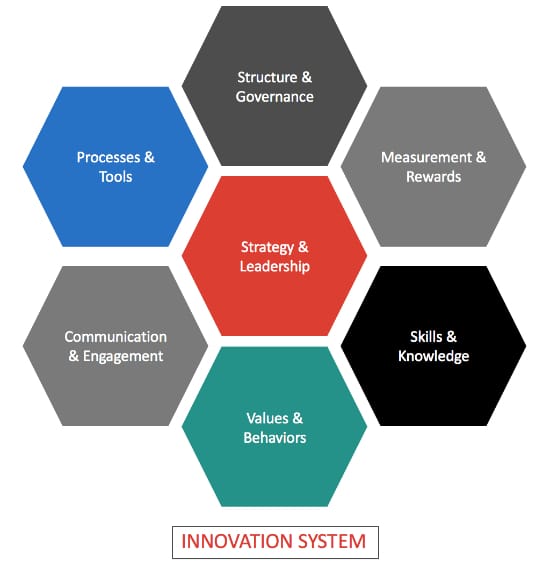
Embedment is possibly the toughest challenge our clients face. Innovation initiatives are easily started but we believe there are 4 critical requirements to make innovation stick.
- Build individual capability
- Demonstrate tangible market wins
- Surround individuals with organisational capacity
- Focus, communicate and engage effectively
Change doesn’t happen overnight, and embedding innovation (culture) is a long-term game.