
Why inclusive strategy creation is imperative
Much has changed since 2020, but much has returned to how things were before COVID-19. The one change that endured is that today, we are a hybrid, mobile, distributed workforce. While this has its advantages, it also means culture develops differently, and cohesion is at risk.
What hasn’t changed is that strategy creation still seems to be the domain of the C-suite. Leadership is at risk of becoming even further removed from the periphery, where the organization’s eyes and ears reside, and customer interaction occurs. So the real question becomes: how do we incorporate inclusivity and diversity into core business processes, such as strategy creation and development?
Since 1995, we have collaborated with over 400 clients whose senior executives realized that most of what could be known about their business resides outside the closed doors of the boardroom. These progressive leaders sought a different approach to strategy development and approached Strategos for support.
Before diving into the particulars, there are four main reasons why inclusive strategy creation is imperative to a business.
1) enhanced innovation
Diverse teams bring a range of perspectives, experiences, and problem-solving approaches. This diversity is the breeding ground for—and enhances—breakthrough ideas and innovative solutions. A homogeneous group might miss out on these unique insights.
2) fueling growth
An inclusive strategy allows organizations to develop a broader range of options. By understanding and addressing the needs of diverse customer segments, identifying discontinuities early, challenging competitive rules, and leveraging core competencies, businesses can tap into new markets and revenue streams to grow in adjacencies and transformational spaces.
3) risk management
A diverse team is more likely to identify potential risks from various angles and identify critical assumptions about the strategic options it is considering. The trick is to learn about new opportunities faster than to commit resources: learn before you earn.
4) talent attraction and retention
In the war for talent, inclusivity and diversity are not just nice-to-haves but assets to leverage. Today’s top talent values inclusivity, which includes being heard and even participating in developing innovative strategies. A compelling strategy needs to resonate not just with customers but also with employees if we expect them to rally behind it.
What inclusive strategy creation really means
Inclusivity goes beyond mere representation. It’s not just about having diverse team members but ensuring their voices are heard, respected, and integrated into decision-making processes.
To make this approach stick and produce results, four requirements are essential:
1) beyond representation
While having a diverse workforce is essential, it’s the engagement, empowerment, and value derived from this diversity that makes the difference. To promote greater diversity, team members are chosen based on criteria other than seniority or politics. In all our client projects, we seek diversity along various dimensions such as experience, industry, level, function, gender, character, etc.
Having different people working together is how to successfully embed inclusivity in your organization. Working in teams on strategy development creates mutual understanding and respect for diverse viewpoints from people with diverse backgrounds.
2) cultural competence
The ability to understand, communicate with, and interact effectively with people from different cultures is especially critical for global businesses. In a globalized world, cultural competence is a must-have skill for organizations. And when workforces are distributed and often remote, the challenge of effective communication becomes even more significant. This competence allows us to adapt processes and tools to match cultural backgrounds and ensure maximum participation.
3) leadership commitment
Leaders set the tone. Leaders can inspire the organization to follow suit by promoting and valuing inclusivity. Trust is the foundation of any successful strategy. By showing commitment and communicating openly about the goals, progress, and outcomes of the strategy, organizations can build and maintain this trust.
4) stakeholder engagement
Actively seek input from a diverse range of stakeholders. This enriches the strategy and fosters a sense of stakeholder ownership and commitment. The world is dynamic, and so are stakeholder needs. Organizations must be agile, continuously learning and adapting strategies to stay relevant.
How to make strategy creation inclusive without losing focus
Inclusive strategy creation is not “strategy by committee.” It’s a disciplined process that expands inputs while protecting decision rights.
A practical rule of thumb:
- widen participation during discovery and option-generation
- tighten decision-making during choices and commitments
- widen again during rollout and learning
Here are a few ways organizations can make that real:
- use clear roles (who contributes, who decides, who executes)
- design participation intentionally (not whoever is loudest or most available)
- separate exploration from commitment (avoid premature convergence)
- make assumptions visible (and test them early)
- build shared language (so teams can debate strategy, not talk past each other)
A different approach to strategy creation
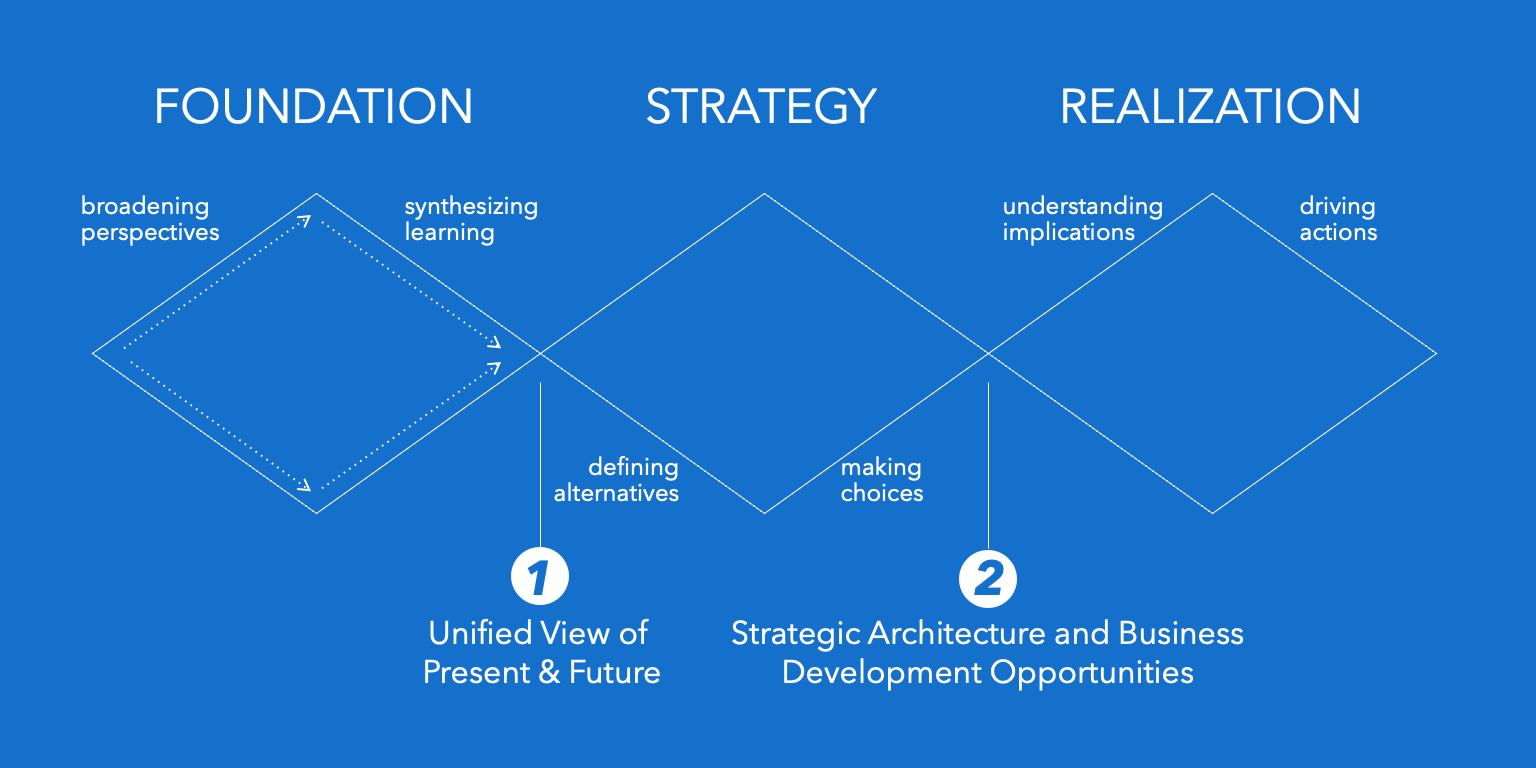
Our Strategic Architecture Process is an inclusive and open approach that helps decision-makers create compelling, differentiated strategies by following fundamental principles.
1) open up the process
Strategy creation should be a pluralistic, participative, and inclusive process that involves employees from diverse backgrounds within your organization, using a range of selection criteria rather than limiting it to seniority. This ensures a wide range of perspectives and ideas, fostering innovation and creativity and encouraging new conversations that break the cycle of the same people discussing the same issues.
This can lead to new perspectives and insights—and a more robust strategy that resonates across and beyond the organization.
2) raise the ambition
The goal should be competitive innovation instead of competitive imitation. Instead of simply playing the same game better, aim to fundamentally change the game in ways that differentiate and create value that matters to customers. Applying approaches used for innovation to strategy-making will achieve this much better than traditional competitive and market analysis.
3) create balance
Your strategy should require you to make tough choices and to be clear about which initiatives to stop, start, and keep. Re-allocate investments where they impact the most and re-align your portfolio to create a focus for marketing and sales teams in the short term while you explore new areas of opportunity to fill the gaps.
4) use a structured approach
The Strategic Architecture Process is highly structured to ensure progress and facilitate broader participation. Traditional strategy development extrapolates from the past to the present and into the future, matching ambitions with available resources. Instead of this method of strategic fit, our future-back approach starts with defining a united view of the future that introduces stretch and challenges the organization to find innovative ways to meet its goals.
We achieve this stretch by diverging and converging in each major step so inclusive input produces real options, and real options lead to better informed decisions.
Overcoming challenges in inclusive strategy creation
While the benefits of an inclusive strategy creation process are evident, implementing it is challenging. In our experience, leaders can face resistance, skepticism, and concerns about confidentiality.
Our Strategic Architecture Process is designed to avoid the common pitfalls of strategy development:
- Ambitious goals are essential, but imposing an unrealistically short time frame invites disaster
- The gap between formulation and implementation often results in a theoretical exercise that doesn’t lead to ownership and action
- Organizational hierarchy undermines competitiveness by fostering an elitist view of management that often disenfranchises most of the organization
Employees should identify with the strategy and feel a part of its creation and execution.
To reduce friction while increasing inclusivity, leaders can also:
- set confidentiality boundaries upfront, e.g. what’s open, what’s not, and why
- use “proof over persuasion”, i.e. test assumptions with quick learning loops
- show visible adoption, e.g. where input changed the direction, and where it didn’t, plus the rationale
- treat alignment as a deliverable not a hope
Signals your strategy creation process is working
Inclusive strategy creation should lead to better decisions and faster commitment. Useful indicators include:
- clearer strategic choices and fewer “everything is important” plans
- stronger understanding of customer and market discontinuities
- earlier identification of risks and assumptions
- more ownership in implementation teams
- increased cross-functional collaboration and shared accountability
The future of inclusive strategy creation
Inclusivity should be core to strategy development. For senior leaders, now is the time to embrace and champion an inclusive approach to strategy creation. The benefits are manifold—from enhanced innovation and market expansion to robust risk management and talent attraction.
As hybrid work becomes normal and competitive rules keep shifting, the organizations that win won’t just have “a strategy.” They’ll have a capability for learning faster than the market changes.
Ready to dive deeper?
Creating a compelling, differentiating strategy is a complex task that requires a deep understanding of your organization, your competitors, and the market. It involves creativity, innovation, and the ability to engage your entire organization. At Strategos, we specialize in helping organizations navigate this process. We bring an inclusive approach and collaborate with you to create a strategy that differentiates your organization to drive innovation and growth. Contact us today to learn more about how we can help.
Further reading and resources
For those keen on deepening their understanding, we recommend the following resources:
- Strategic Intent, Gary Hamel
- Innovation to the Core, Strategos
- Develop a Winning Growth Strategy (video), Strategos