Predict the Future by Creating It
Many leadership teams make efforts to predict the future. Yet despite better data, more dashboards, and tighter planning cycles, many C-suites still feel one step behind customers, competitors, and technology developments.
Transformation with future-back strategy
While boards and investors ask for clear growth stories, markets shift faster than annual plans. The organization gets better at what it already does, while the business landscape around it keeps changing.
Peter Drucker famously said that “The best way to predict the future is to create it”.
The futures that matter most to your business can’t be predicted by analytics and extrapolation alone. They are shaped by the strategic choices you make now.
That’s why we work from the future back. Instead of asking “What will happen to us?”, we help leaders decide, “What future are we determined to create, how do we make an impact, and what will we do today to move towards it?”
From predict the future to leading with future-back strategy
Traditional strategy and planning are powerful, but they are mostly present-forward. They start with today’s context and project that reality into a future that we can accept.
While this approach is good for optimizing your current business model it is less effective when your industry is being redefined, when customer expectations are shifting, or when new business models emerge from outside your category.
The future-back approach starts from the opposite direction
You first define the future in which you intend to win. You build an insight-based view of how your customers’ world is changing, how industry boundaries may blur, and which capabilities and assets you can uniquely leverage. You then decide the strategic space where you want to win in that future.
Only after that do you work backwards to today and ask: “If this is the future we are committed to, what must we start building, testing, and investing in now?”
In short, the future-back approach is the discipline of defining the future you want to lead, then working back to today’s decisions.
A simple metaphor: “Back to the Future”
Think of the movie “Back to the Future”.
Marty McFly travels forward in time and sees a version of his life and his family he doesn’t want. That future is not a forecast; it is a provocation. It forces him to ask: “If I don’t like this future, what must change in the present?” He then works backwards. By understanding the future he wants, and the one he wants to avoid, he identifies the critical moments, relationships, and decisions that need to be reshaped now.
That is what future back means in a strategic context. You don’t sit and try to predict the future as if it were fixed. You imagine a vivid, insight-driven future you would be proud to lead. Then you trace back the moves, capabilities, and experiments required today to bend your trajectory towards it.
Migration Maps: turning future-back strategy into coherent action
A vision of the future state is not enough. C-suite leaders need a way to connect that vision to capital allocation, portfolios, and capability building. That is what Migration Maps are designed to do.
A Migration Map is not a detailed project plan. It is a single-page strategic narrative laid out over time.
It connects three elements.
- First, a clearly articulated future state. This is a concise description of the differentiated position you want to hold in 5–10 years, the customers you will serve, and the value you will be delivering.
- Second, a clear view of your starting point. Your current business models, capabilities, market positions, and constraints.
- Third, a set of reinforcing paths that show how you will migrate from today to that future. These paths include new offerings and experiences, new channels and partners, critical capabilities (for example in digital, data or advanced materials), and the enabling systems, governance and culture that must develop in parallel.
On a Migration Map, these streams sit together on one page. This allows leadership teams to see how initiatives build on one another over time, rather than managing them as disconnected projects. It becomes much easier to stop low-value activity, focus resources, and make deliberate trade-offs.
For the C-suite, the Migration Map becomes a reference point you can return to in every strategy review and budget cycle. It links your future-back strategy to concrete choices about where to invest, what to scale, and what to let go.
How we helped Crayola transform
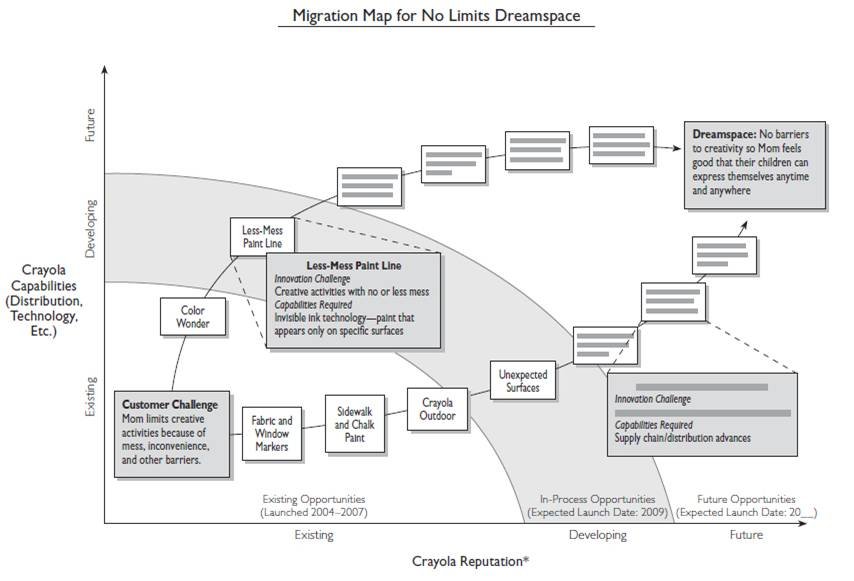
Our work with Crayola offers a practical illustration of future-back thinking in action.
For more than a century, Crayola was synonymous with crayons. That association was powerful, but it also risked limiting how retailers, parents and children saw the brand.
In the mid-2000s, Crayola deliberately set out to move beyond “wax sticks” and reposition itself as a provider of novel, low-mess creative experiences for children and families. The future state they described was one in which creativity was easier, more accessible, and more acceptable to parents—captured in the internal ambition often described as “No Limits, No Mess.”
Seen through a future-back lens, this aspiration had clear implications. Crayola would need new chemistry and electronics capabilities, new product formats, new in-store presentations, and new ways of engaging consumers online.
Using a Migration Map, they explored:
- How their role in the world of children’s creativity should evolve over several years.
- Which capabilities had to be built, partnered for or acquired.
- How new offerings, channels and capabilities would reinforce one another step by step.
Rather than waiting to see where the category would move and trying to predict the future of kids’ products, Crayola chose to compete for the future it aspired to. It invested in the paths and capabilities required to be seen as an experience brand, not just a crayon manufacturer.
Why future-back and migration maps matter for the C-Suite
For senior leaders and strategy or innovation teams, a future-back approach supported by Migration Maps brings several advantages.
It forces clarity. You cannot work future back without a clear and shared point of view on the future you intend to shape and the bets you are willing to make.
- It aligns leadership. When everyone around the table can see how today’s initiatives connect to a longer-term ambition on a single page, trade-offs become explicit and productive, rather than political.
- It connects strategy and innovation. Migration Maps put growth platforms, innovation initiatives, and capability building in the same frame. They reduce the gap between “the strategy slide deck” and the innovation work happening at the edges of the business.
- It remains adaptive. The future will not unfold exactly as imagined. A Migration Map is reviewed and updated as you learn. It guides decisions without becoming a rigid blueprint.
Most importantly, it shifts your posture. Instead of trying to predict the future in spreadsheets and hoping you can react fast enough when the future unfolds, you are building the organizational capabilities to shape the future you want to lead.
Where to go next
If you sense the limits of traditional, present-forward planning and want to lead from a future-back perspective, two questions are a useful starting point:
- Do we have an insight-driven, shared point of view of the future we intend to compete in and win?
- Are our strategy and innovation efforts truly aligned to that future, or are they mainly optimizing the present?
We work with leadership teams to answer those questions, design migration maps, and embed future-back strategy into how you set direction, allocate resources, and pursue growth.
If you want to explore what this could look like in your context, the natural next step is to dive deeper into how we support:
Strategy – defining future-state growth ambitions, choices and migration paths.
Innovation – building the systems and capabilities required to make that future real.
From here, continue to our Strategy or Innovation services pages to see how we help organizations like yours compete for their future, not just forecast it.