Why are innovation principles important?
In our article Innovation Principles Part 1, we introduced the nine principles that guide how we work with clients, and we examined the first three that help us ‘inform’.
As a reminder, innovation principles last longer than methods and approaches; principles serve as guides that allow us to evolve methods and adapt them to client situations. Whether we are working with clients to develop a new innovation strategy or addressing specific innovation challenges, these nine principles apply.
In this article, we look at the next set of principles, those that help us to ‘execute’ innovation.
Innovation Principles to Execute Innovation
Principle #4:
Seek innovation at the level of the business model
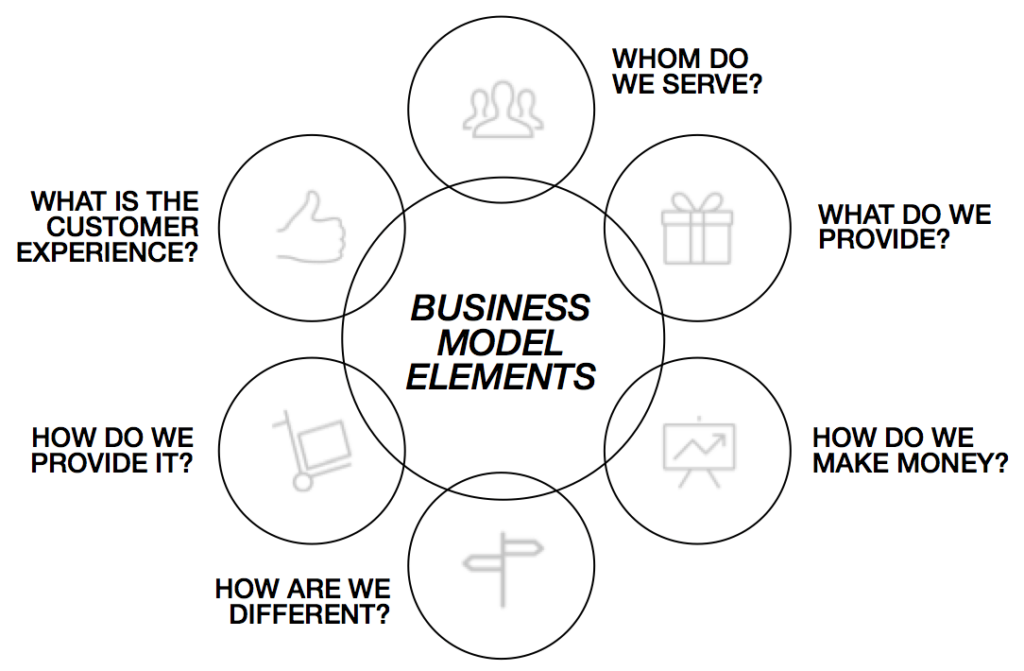
We believe that to fully ‘execute’ innovation concepts, it is essential to consider the many facets of the business model. Our simple model, shown below, enables us to examine each aspect of the overall business and challenge our clients to differentiate as many of these as possible. For example, can we stretch and improve the emotional and functional benefits we offer? Can we explore alternative ways of generating revenue? Is there a different or unique method to deliver the concept or service?
In our experience it is not simply enough to come up with a new product with a distinctive set of features but it is necessary to ‘bundle’ a set of business model components to make the eventual product/service really innovative. A good example is the iPhone – a great device with a set of killer features but what really made the iPhone a truly great innovation was the business model built around it – the tie-ups with telcos, the apps, the link to the wider Apple eco-system such as iCloud. Another great example is Nespresso – not just great coffee dispensed from well-designed machines, but a radical business model based around simplicity and convenience at a premium price.
And finally, another example from the B2B space is Rolls Royce, which transformed its business model in the early 2000s with the introduction ofs new service mo TotalCare®. Thidel allowed them to share risk and reward with their customers, moving away from the traditional maintenance-and-repair approach. TotalCare covers service elements such as predictive maintenance planning, workshop creation, and all off-wing repair and overhaul activities. Essentially, TotalCare® rewards reliability, a factor highly valued by customers, and customers are billed on a $/engine flying hour basis. By 2010, 65% of all in-service large engines were covered by TotalCare®.
Principle #5:
Evaluate new opportunities using different criteria
If we keep using the same old ‘stage-gates’ or metrics for our new innovations as we did in the past, we will likely find that many of the same opportunities fail to pass the evaluation hurdles. This leads to a lack of competitiveness and results in very incremental offerings.
While this may be acceptable in a very stable market or industry where there is an industry-wide set of acceptedcomes are heavily regulated, like pharmaceutical metrics and outs, it is not acceptable in fast-moving industries with rapidly changing business models. Therefore, we need to review the overall business model needed for the given product or service.
A good example is the telecom sector. Where only a few years ago the key metrics were purely transactional, such as voice minutes and text messages, today the metrics focus much more on data usage, service adoption, app purchases, and customer loyalty. Currently, existing customers get better deals than new customers, compared to a few years ago, when everything was centered on expanding market share. Any telecom using the same metrics as even two years ago will not be evaluating new opportunities with a clear understanding of the current market demands.
So, the question we must consistently ask is … ‘given the current and likely future state of the sector/industry, what are the key components of the overall business model that we need to evaluate new innovations against?’
Principle #6:
De-risk through in-market learning and experimentation
Typically, any new idea, regardless of how brilliant, is not complete. There are a set of assumptions and hypotheses surrounding the implementation of the idea that you need to test before committing the large budget required for a market launch. Again, we find ourselves revisiting the business model, deconstructing the offering and the business model into smaller parts, and testing each one. Experimentation involves testing three things in the following priority.
- Will they buy it? Who is the customer, and what are the benefits?
- Can we provide it? What is the desired consumer experience journey, capabilities required, etc?
- Can we make money? e.g., are our assumptions about the correct price point accurate? Are our assumptions about purchase frequency correct?
The best experiments require a reciprocal exchange of value between the customer and the provider so we can analyze the results of that exchange and make adjustments for the next iteration of the concept. Often, this does not occur in the final purchase or consumption setting and doesn’t always need to involve branded prototypes. It certainly isn’t about panels, market tests of complete concepts, or testing every aspect of the new idea all at once.
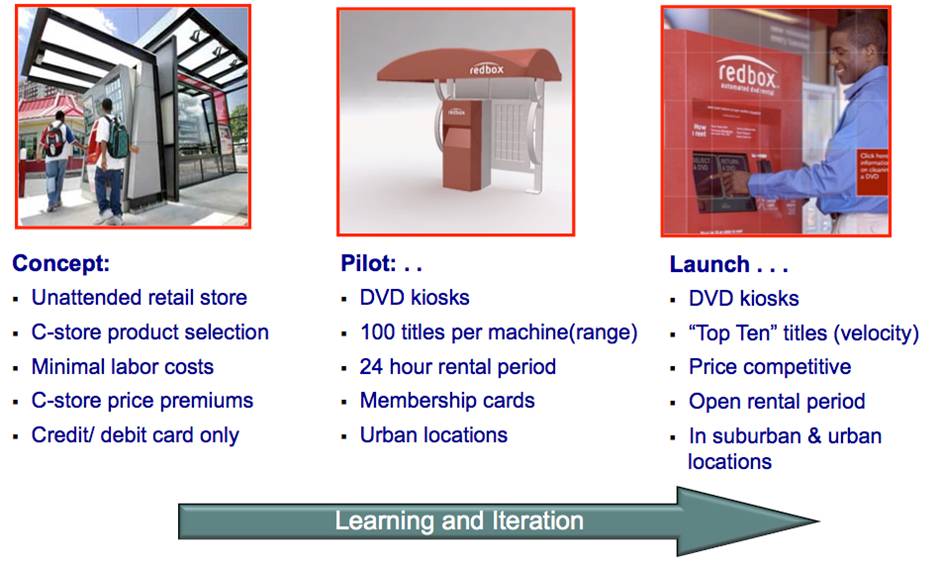
A great example of de-risking through experimentation is Redbox. The original idea of an unattended retail store was quickly tested and lessons learned. From this, a very different pilot was launched, and again, by applying the key lessons, the final version was quite different but still based on an understanding of what customers wanted, at what price, and in which locations. This has made the concept ultimately very successful.
In our final article in this series, we will examine the principles that help to embed innovation.