
An innovation assessment helps executives make informed decisions about investing in innovation. Every year, businesses allocate more resources to innovation capabilities in pursuit of growth, as studies demonstrate a direct link between innovation and financial performance. Some of this confidence seems misplaced, as many executives are disappointed with the return on their innovation investments. It is clear to most that just spending more doesn’t automatically lead to success.
Top performers in innovation make their investment choices wisely and base them on understanding the gap between their current capabilities and what is needed to deliver outstanding, world-class performance. That gap becomes visible when you run an innovation assessment that is grounded in evidence, designed as an innovation assessment framework, and repeated over time as an innovation maturity assessment.
An assessment done the Strategos way distinguishes between capability (what the organisation can repeatedly do) and performance (what it has delivered so far), and it links both to strategic intent—the direction and degree of ambition that shape choices.
Four steps toward a world-class innovation capability
Every organisation innovates; you are never starting from a greenfield. Whether you are the CXO responsible for innovation or the executive sponsor, there are four moves that create a virtuous cycle of improvement:
Step 1 – Run a capability assessment to establish your baseline.
Step 2 – Define ambition and scope (strategic intent) for innovation.
Step 3 – Identify gaps and design the portfolio and capability moves to close them.
Step 4 – Monitor progress, learn, and reallocate resources on a regular cadence.
This article focuses on Step 1 and Step 4, the bookends that convert a one‑time diagnosis into a living innovation maturity assessment.
How to perform innovation assessments
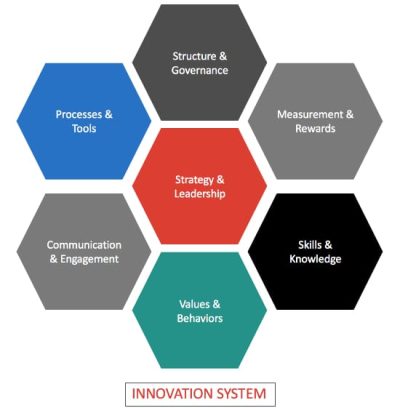
We have been evaluating client innovation capabilities and developing innovation strategies since 1995. The strategos innovation system defines requirements that clearly distinguish between baseline and world-class innovation capabilities. Strategos tested and refined these requirements through dozens of engagements across several industries.
Our Innovation System Framework
We have developed a proprietary toolbox to assess a company’s innovation capability through surveys, interviews, workshops and case-based research. Used together, these methods create a stronger innovation capability assessment than any single data source can provide, because you can cross-check what people believe with what the organisation actually does.
A useful innovation assessment framework typically looks across the end-to-end innovation system. It examines leadership intent, strategy and portfolio choices, decision processes, team skills, ways of working, culture, and the enabling infrastructure required to scale learning into performance. All these elements need to work together to shift from ad-hoc innovation initiatives to making innovation stick in an organization.
Assessing innovation maturity
We score each dimension from the innovation system framework on a 0–5 scale with concise descriptors:
- 0 – Absent: No consistent practice; outcomes depend on luck or heroes.
- 1 – Emerging: Ad‑hoc practice in pockets; limited evidence of results.
- 2 – Foundational: Documented practices; inconsistent application; basic metrics.
- 3 – Established: Consistent practice across units; decisions evidence‑informed; improving metrics.
- 4 – Leading: Systemic capability; metered funding; rapid learning cycles; clear scaling pathways.
- 5 – World‑class: Organisation continuously renews; portfolio delivers outsized growth; culture and systems reinforce reinvention.
A heatmap makes gaps visible between the current maturity level and the shift in capability development that is necessary to meet the organization’s ambition and scope from step 2.
Ask verifiable questions in your innovation assessment
Innovation assessments should separate popular opinion from fact. The quality of the result depends on the topics covered, how you formulate the questions, and what answers respondents can select. Most assessments over-rely on opinion scales. These produce attractive charts but weak decisions.
The following examples illustrate this point.
Opinion-led (weaker): Is our organisation willing to take risks?
Possible answers: Often. Sometimes. Hardly ever. Not at all.
Verifiable (stronger): Do we have a strategy for innovation?
Possible answers:
- It is documented and actively communicated.
- It is documented and accessible to anyone.
- Only senior executives have access.
- We do not have one.
The first question leads to opinion; everyone will interpret risk in different ways, whereas the second one can be verified. This is one of the simplest upgrades you can make to an innovation assessment: design questions so answers can be tested against observable evidence.
Additional examples:
- Innovation strategy: “A current innovation strategy exists, is documented, and is reviewed at least twice per year.” Yes and widely communicated / Yes and accessible / Draft only / No.
- Portfolio: “We maintain a single enterprise view of the portfolio classified by where we play and how we win (core/adjacent/transformational).” Yes / Partial / No.
- Governance: “An innovation or venture board with cross-functional decision rights allocates funding based on evidence.” Exists and operating / Exists but ad‑hoc / Planned / No.
- Scaling: “There is a named landing zone and sponsor for each new venture prior to pilot.” Yes / Partial / No.
Opinions are essential signals to consider and shouldn’t be confused with facts that could potentially lead to taking the wrong actions. A strong innovation capability assessment uses both, making the difference explicit so leaders know what to fix first.
Combine qualitative and quantitative data
Performance data helps us to verify some of the answers that people give and also provide further visibility into input, throughput and the output as a result of your investments in innovation to date. This picture may be incomplete because as many as 25% of companies do not track the impact of innovation directly. Metrics are essential and necessary to monitoring progress and measuring impact.
A practical innovation assessment framework links data to decisions. It clarifies what you invest in, what moves through the system, what gets scaled, and what value is created. When you repeat the assessment as an innovation maturity assessment, the numbers become trend lines, and trend lines change conversations from “who’s right” to “what will we do next.”
Look for barriers and enablers
Often, the most critical obstacles for innovation are not processes or resource constraints, but embedded beliefs about how the business should operate. These beliefs can prevent people from being productive and in the worst cases, cause innovations to halt altogether. Examining past innovation cases help us identify these barriers that we’ll need to address as well as surface strong enablers that we can leverage.
This is where an innovation assessment becomes more than a score. It becomes a guide to constraints and opportunities, helping focus investments on the few shifts that produce the most progress.
Visualise internal innovation communities
When you’re a startup, you know everybody that’s working in the company. But the largest of businesses often have pockets of innovation in different parts of the organisation with varying levels of sophistication and visibility. We understand that these informal networks or communities of practice are vital to solving problems and developing new ideas.
Worlds class innovators identify and leverage these pockets of capability and provide support to strengthen and scale their impact on performance. Our innovation assessment visualises those internal networks and finds ways to strengthen them. When you treat this as part of an innovation capability assessment, you stop relying on a few heroes and start building repeatable capability across the organisation.
What “good” looks like
A useful innovation assessment delivers clarity, alignment, and action:
- A shared language for “what good looks like” and where you are today
- A small set of high-leverage moves to close gaps to world-class
- A portfolio that is balanced by uncertainty and backed by metered funding
- A cadence that turns learning into better bets—and better results—every quarter
Run it repeatedly and it becomes a maturity system that supports implementation, drives behaviour change, and keeps innovation tethered to measurable outcomes.
Ready to see this in action?
See how an Innovation Assessment can work in your organisation
No obligation. Just a focused conversation about what’s possible for your organisation.