
Three months after the “big innovation kickoff,” the pipeline looked great on paper: dozens of ideas, energetic teams, a new portal, and plenty of activity. Yet the leadership team still asked the same blunt question in the quarterly review: “So…what changed?” That moment is where innovation strategy stops being a buzzword and becomes a management discipline—because without clear choices on focus, funding, and follow-through, innovation activity rarely turns into innovation performance.
The three failure modes that signal a lack of an innovation strategy
Although they are not the only signals, these three failure modes frequently appear in Strategos’ work with clients. An innovation strategy helps you address these challenges and ensures innovation gets the attention it needs to consistently deliver results.
Never a good time to invest. Innovation gets squeezed in downturns (cost pressure) and upturns (capacity pressure). Your innovation strategy needs a protected investment logic.
Innovation is everywhere. Enthusiasm runs high, and there are many pockets of good examples of innovation, but these efforts remain disconnected. 75% of large organizations lack a well-structured innovation process, making innovation mostly ad hoc.
Silver bullet syndrome. We see companies acting on the hope that implementing single tools will somehow make them innovative. While these point solutions can be useful, in isolation, they rarely produce significant and lasting results, and the excitement for innovation quickly fades. Tools matter: design thinking, lean startup, idea platforms, but none can replace a comprehensive innovation strategy and system.
Why innovation strategy matters now
The readiness gap is real. McKinsey reports that over 80% of executives say innovation is a top-three priority, but less than 10% are satisfied with their organization’s innovation performance. BCG found that 83% of senior executives rank innovation in their top three priorities, yet only 3% of companies in 2024 qualify as “innovation ready.”
Strategos observes the same pattern in practice: the disappointment isn’t due to a lack of ideas—it’s caused by a mismatch between expectations, scope, and investment, along with an operating system that can’t reliably convert learning into scale.
What an innovation strategy is
Strategos’ definition is deliberately practical:
Innovation strategy in one box
A strong innovation strategy makes five choices explicit:
- Why innovate (the growth problem you’re solving)
- Where to play (the opportunity arenas you will prioritize)
- What outcomes matter (financial + strategic results)
- How you’ll build and govern the portfolio (investment logic, decision rights)
- How you’ll execute (capabilities, cadence, metrics, scaling path)
The framework: five steps to build an innovation strategy
Think of this as a repeatable blueprint you can run every few years (the cycle depends on your industry dynamics) and review periodicaly.
Step 1: align leadership on why, where, and outcomes
This step is less about “getting buy-in” and more about getting leaders to make trade-offs together—because innovation competes with the core business every quarter.
Start the executive dialogue with three moves:
- clarify the “why” (and make it defensible). A recurring issue is that innovation gets squeezed because there’s “never a good time to invest,” even when leaders believe it’s important. Your job is to anchor innovation to business reality: growth gaps, margin pressure, disruption risk, regulation, resilience, or strategic repositioning.
- choose where to play based on external change. We are asking leaders to identify external shifts, define their implications, prioritize which shifts the company must address through innovation, and revisit those assumptions periodically. This becomes your short list of opportunity arenas.
- define outcomes beyond “more ideas.” Disappointment happens when leadership expects “disruptive” but funds mostly incremental work. Outcomes should include a mix of:
-
- Growth results (by horizon)
- Strategic outcomes (category leadership, new business models, new capabilities)
- System outcomes (cycle time, learning velocity, scaling rate)
Quick checklist for step 1
If you can’t answer these clearly, your innovation strategy isn’t ready:
- What (growth) problem is innovation solving in the next 3–5 years?
- What 3–5 opportunity arenas will we prioritize?
- What results (not activities) will define success?
- What assumptions are we making about the future, and how will we monitor them?
Step 2: set innovation scope and investment logic
Innovation strategy fails when scope is vague (“innovation everywhere”) and resources are scattered across ad hoc initiatives. In Strategos’ experience, you need to explicitly distinguish core performance from renewal, otherwise future-growth work loses funding battles to this quarter’s commitments.
A useful starting benchmark to guide investments (HBR reference): allocate ~70% to core, ~20% to adjacent, and ~10%to transformational innovation. We generally adjust these numbers based on your industry characteristics and level of ambition, degree of shift required in your portfolio etc.
Even when leaders believe innovation is key, many organizations still skew heavily toward incremental work. That’s not “wrong”, but it becomes a problem if your growth story depends on new platforms and you’re funding almost none of the discovery and capability-building required to get there.
Step 3: build a balanced innovation portfolio (not a slogan)
A credible innovation strategy translates ambition into a portfolio you can govern.
Strategos uses a simple but effective leadership exercise: map initiatives by where to play (core/adjacent/new) and how to win (leverage existing capabilities vs. build new ones). The point isn’t perfect categorization; it’s to make trade-offs visible so the executive team can fund the portfolio that matches the strategy.
Quick checklist for step 3
- Do we have a clear view of our current portfolio by different dimensions?
- Are we investing enough in the capabilities needed for the “new” opportunities?
- Do we stop projects decisively when learning says “no”?
- Do we have a defined path from discovery → validation → scaling?
Step 4: design the innovation system that makes performance repeatable
This is the part most organizations underinvest in. Strategos argues for “professionalizing innovation management,” so it becomes a discipline without killing creativity.
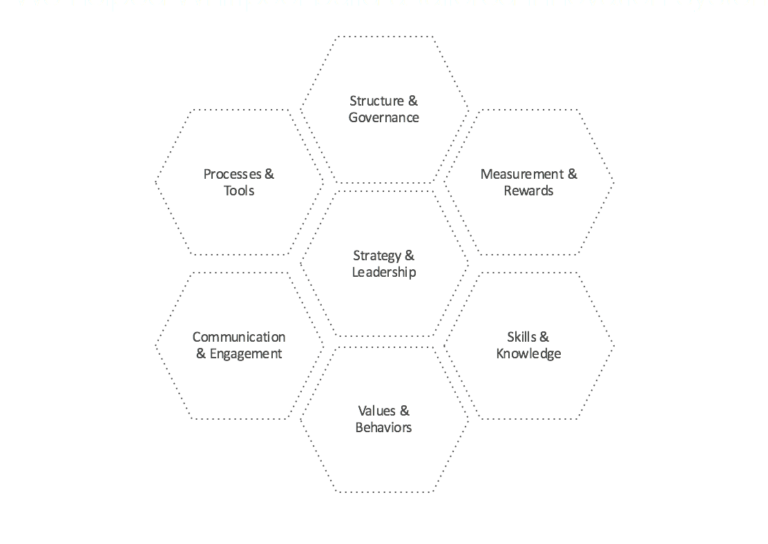
An effective innovation system typically includes:
Governance and decision rights. Who decides what gets funded, what gets stopped, and what gets scaled? Misaligned decision rules often create “pilot purgatory,” where teams can experiment but can’t scale.
A practical cadence many leadership teams can sustain:
- Monthly portfolio review (stop/continue/accelerate based on evidence)
- Quarterly resource reallocation (shift talent and funding across bets)
- Annual innovation strategy refresh (tied to corporate planning)
Capabilities matched to your scope. If your ambition includes new growth platforms, you’ll need more than ideation: discovery, opportunity framing, experimentation, business model design, commercialization, and scaling capability.
Infrastructure that protects non-core work. There may be a need for specialized structures, such as incubators/accelerators, to nurture ideas that don’t fit the core while still connecting to commercialization paths.
Metrics that track outcomes and learning (not just activity). Balance input, throughput, and output measures so leaders can manage innovation like a portfolio, not a program.
We use our Innovation System Framework to guide the design for our clients:
Step 5: execute with a stepwise plan that tackles real barriers first
Big “master plans” often die because they appear expensive, abstract, and disruptive to day-to-day operations. Strategos recommends a stepwise approach: assess barriers, prioritize the critical few, work on real innovation with teams, and build capabilities while delivering value.
The hardest barriers are often belief-based, embedded assumptions about what “good” looks like (for example, prioritizing asset utilization can unintentionally block non-core growth ideas). If you don’t surface those beliefs before you start, no amount of tools will fix the system.
A practical 90–180 day sequence:
- Leadership alignment on arenas, outcomes, and investment logic
- Portfolio mapping and system diagnosis (governance, metrics, processes, culture)
- Barrier scan (including belief-based barriers and incentives)
- Pilot the new system on a small set of priority opportunities or challenges (so you learn fast and allow teams to develop new capabilities)
- Scale what works: codify playbooks, upgrade governance, develop internal coaches
How Strategos helps improve innovation performance
Strategos helps clients improve innovation performance by turning ambition into an actionable innovation strategy and the operating system required to deliver it. Based on the approach described here, we typically support clients to:
- Run leadership dialogues that clarify why, where, scope, and outcomes
- Diagnose portfolios and innovation systems (including hidden barriers)
- Design governance, capabilities, and metrics that make innovation repeatable
- Build a stepwise roadmap and develop capability through solving real business challenges
Typical deliverables:
- Innovation strategy on a page (choices, arenas, outcomes, investment logic)
- Portfolio map and decision criteria by horizon
- Innovation system design (governance, capabilities, metrics, cadence)
- Stepwise implementation plan tied to real initiatives and learning goals
Conclusion
A strong innovation strategy is not a document but a set of choices you can execute: leadership alignment on direction and outcomes, a portfolio that matches ambition, and an innovation system that professionalizes governance and scaling without suffocating creativity. If your CEO asked tomorrow what growth your innovation strategy is truly delivering and what will scale in the next 12–24 months, would your answers be specific, evidence-based, and aligned across the leadership team?
FAQ Innovation Strategy
An innovation strategy is the set of choices that defines why you innovate, where you will focus, what outcomes you will deliver, and how you will fund, govern, and measure innovation so it becomes repeatable. It turns innovation from activity into performance by aligning leadership intent, portfolio priorities, and an operating system (governance, capabilities, metrics).
You develop an innovation strategy by making five decisions explicit:
Why innovate: the growth problem you’re solving (e.g., new growth, resilience, margin, disruption risk)
Where to play: priority opportunity arenas based on external change and advantage
What outcomes matter: financial and strategic targets by time horizon
How you’ll run the portfolio: investment logic (core/adjacent/transformational), decision criteria, resourcing
How you’ll deliver: governance, capabilities, metrics, and a cadence that drives learning and scaling
An innovation strategy sets direction and resource choices (the “why” and “what”). An innovation process defines how work moves from discovery to validation to scaling (the “how”). An idea program collects inputs, but it’s not a strategy by itself. You need both strategy and system to avoid scattered activity and to enable scaling.
Strategos helps organizations improve innovation performance by turning innovation intent into an actionable innovation strategy and operating system. That typically includes leadership alignment on opportunity arenas and outcomes, portfolio diagnosis and prioritization, governance and decision-rights design, capability building (from discovery through scaling), and metrics that guide funding and talent allocation.