
It might seem contradictory: a process as spontaneous and creative as innovation can and should be measured. At Strategos, we believe innovation can be taught, learned, and systematically applied by establishing the right processes, systems, structures, skills … and innovation metrics.
When done well, innovation metrics do more than just ‘report numbers.” They help you track and steer the development of your innovation system. If you don’t know what’s broken, how can you fix it? And as the old saying goes: ‘You get what you measure.’ In other words, metrics send a clear message that you are committed to innovation and help establish the behaviors you want throughout the organization.
Strategos published an earlier article on this topic in 2005. Surprisingly, there has been relatively little published on this topic since then. Is it because companies still see innovation as a capability that doesn’t lend itself to measurement? Or is it because how to measure innovation can seem complex, cumbersome, and generally daunting?
To make the topic less intimidating, this guide provides practical guidelines to help you start designing and implementing a systematic way to measure innovation without overcomplicating it.
Why Innovation Metrics Matter
Innovation often involves longer time horizons and higher uncertainty than “business as usual.” That’s exactly why measurement matters. Strong metrics help leaders and teams:
- Make better decisions with objective data, not just opinions or the “loudest voice.”
- Stay focused on capability-building, not just short-term wins.
- Build credibility and momentum by showing progress and success over time.
- Reinforce culture by rewarding the behaviors that drive innovation.
One of the easiest ways to boost visibility and accountability is by maintaining an innovation dashboard — a small set of metrics that keeps innovation progress front and center for executives and employees.
Measuring Innovation Across the Lifecycle: Input – Process – Output
Traditionally, the most common metrics have been output metrics: number of patents, percentage of products under three years old, percentage of revenue from new products, and so on. In our view, output metrics alone can’t tell the full story and they are of limited help when you’re trying to guide and improve an evolving innovation capability.
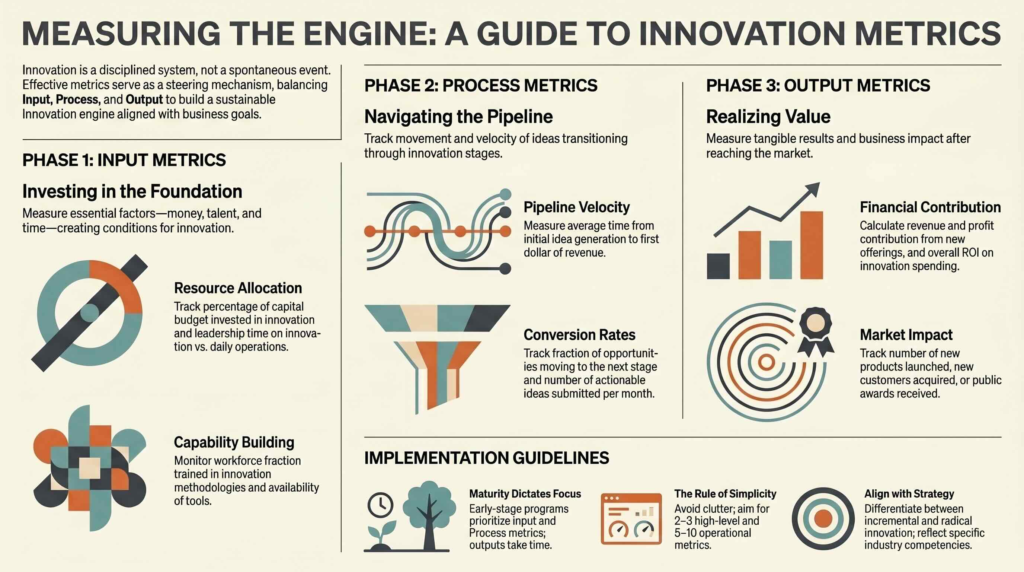
A more useful way to think about how to measure innovation is to define metrics across three categories:
Input Metrics
Input metrics measure the factors that create the conditions for successful innovation. We typically measure these in terms of money, talent, and time invested in innovation.
Examples of input metrics:
- Fraction of the workforce trained in innovation
- Amount of leadership time spent on innovation vs. day-to-day operations
- Fraction of the capital budget invested in innovation projects
- Number of ideas coming from customers or partners
- Availability of innovation tools and methodologies to employees
Process Metrics
Process metrics address variables that affect the movement of ideas through the innovation pipeline.
Examples of process metrics:
- Average time from idea generation to first revenue
- Number of actionable ideas submitted by employees per month
- Fraction of opportunities moving to the next stage
- Number of innovation processes that have been codified and widely embedded
Output Metrics
Output metrics measure the results of innovation.
Examples of output metrics:
- Number of new products or services launched
- Revenue and profit contribution from new offerings
- ROI on innovation spending
- Number of new customers acquired or new markets entered
- Social impact or public awards
Getting Started: Practical Guidelines
Below are guidelines we’ve found useful for helping clients develop a meaningful set of innovation metrics. The goal is not to measure for its own sake—it’s about measuring in a way that enhances your innovation capabilities and supports better decision-making.
1) You can’t measure what hasn’t happened — focus on input
For companies beginning their innovation journey, it’s important to build the systems and processes first so you can accurately measure results. Focus on metrics that promote training, skill development for innovation, and recruiting people with the right mindset and behaviors for innovation.
2) One size does not fit all
The most important factor is your level of innovation maturity. Metrics should be tracked in a way that promotes the development of your innovation system—regardless of the starting point. Also, metrics will vary across industries because the competencies and skills required for innovation differ.
3) Keep it simple
Avoid the tendency to gather every possible data point. Develop metrics that are simple, meaningful, and easy to understand. Metrics are most effective when they are widely used and understood across the company.
4) Leverage existing metrics and methodologies
Your organization might already have metrics in place—find them and evaluate their potential for broader application. If your company employs methods like Balanced Scorecard or Value-Based Management, align your metrics with that framework. If you use a management dashboard, ensure metrics are included. From our experience, modifications to existing metrics are usually more easily accepted than introducing an entirely new set.
5) Don’t be afraid to modify or adapt the metrics
Think of metrics as a living system. As your organization evolves toward higher innovation maturity, your metrics should evolve too. If a metric isn’t giving the insight or guidance you expected, modify it or replace it.
6) Align your metrics with the goals of your innovation program
Before selecting metrics, clarify what you want to achieve. Are you aiming for radical innovation, incremental innovation, or both? Do you want to innovate in your core business and build future businesses? Do you want innovation be “everyone’s job” or the responsibility of a dedicated team? Will you depend on internal ideas, or also source ideas from customers and partners? Are there specific target markets, growth areas, or problems you’re aiming to solve?
Be explicit about the goals before selecting metrics that show progress toward those goals.
7) Include at least one or two customer-driven metrics
Balance internally focused metrics with customer-driven measures, such as sales from new products. If your innovation doesn’t resonate with customers, it likely needs to be reevaluated.
8) Communicate progress with a simple innovation dashboard
A dashboard highlighting your two or three key innovation metrics can greatly help foster an innovative culture. Review it during leadership meetings to maintain executive focus. Share progress widely to boost confidence and participation, and report impact when innovations succeed.
Always remember the goal of your metrics: to monitor progress toward a strong and effective innovation system and capability that supports the company’s goals, and to communicate that progress clearly.
A Final Note on “How to Measure Innovation”
Don’t assume that a sophisticated measurement system replaces management judgment. Strong innovators develop their innovation system alongside decision processes that leverage the information metrics can generate. Ultimately, it’s not just about better knowledge—it’s about better decisions made through better understanding.
With these guidelines in mind, measuring innovation progress should feel less intimidating. Begin small … but stay focused on the true goal: a productive, profitable, and engaging innovation engine.
If you want to develop a focused innovation dashboard, align leaders around what to measure, and build an innovation system that scales read more about how you can achieve this.
Frequently Asked Questions about measuring innovation
Clear, practical answers to common questions we have received from clients about innovation metrics and how to measure innovation.
What are innovation metrics?
Innovation metrics are the measures an organization uses to track how well it creates, tests, and scales new ideas into meaningful outcomes (new products, services, processes, or business models). Good innovation metrics help leaders make better decisions, build capability, and improve performance over time.
Why should we measure innovation at all?
Measuring innovation brings visibility to progress, reduces “gut-feel” debates, and signals that innovation is a strategic priority. Done well, innovation metrics also reinforce the behaviors and habits that build an innovation culture.
How do you measure innovation without killing creativity?
You measure the system, not just the “spark.” Use a small set of innovation metrics that support learning, speed, and customer relevance—especially early on. The goal of how to measure innovation isn’t control; it’s better decisions and better scaling of what works.
What’s the best way to structure innovation metrics?
A practical approach is to balance three categories:
- Input metrics (money, talent, time invested)
- Process metrics (how ideas move through your pipeline)
- Output metrics (customer and business results)
What are examples of innovation metrics we can start with?
Starter examples include:
- Input metrics: % of employees trained in innovation, leadership time allocated to innovation, budget invested in innovation projects
- Process metrics: cycle time from idea to test, number of experiments run, conversion rates between stages
- Output metrics: revenue from new offerings, margin contribution, adoption rate, customer satisfaction for new launches
What’s the difference between leading and lagging innovation metrics?
Leading metrics predict future outcomes (e.g., number of experiments, speed to first prototype). Lagging metrics report results after the fact (e.g., revenue from new products, ROI). A strong set of metrics includes both.
Which innovation metrics matter most for early-stage innovation programs?
Early-stage programs should prioritize input and process metrics because many outputs take time. Useful measures include talent trained, time allocated, pipeline health, speed of testing, and quality of learning—often the most practical answer to how to measure innovation early on.
How many innovation metrics should we track?
Fewer than you think. Many organizations do best with 2–3 executive-level metrics on a dashboard and 5–10 operational metrics that teams use to run the innovation process.
What’s an innovation dashboard, and what should be on it?
An innovation dashboard is a simple view of the key innovation metrics leaders use to steer innovation. A strong dashboard often includes:
- One input metric (capability investment)
- One process metric (speed/flow/learning)
- One output metric (customer or business result)
How often should we review how we measure innovation?
Match the cadence to decisions: many teams review pipeline health and experiments monthly; portfolio alignment quarterly; and output impact (revenue, margin, growth) biannually or annually. Review innovation metrics at the pace you’re willing to act.
Who should be responsible?
Ownership is shared: leadership uses the dashboard to make portfolio decisions; innovation leaders (or a PMO) own definitions and reporting; teams own operational innovation metrics tied to learning and delivery.
What are the most common mistakes when measuring innovation?
Common traps include measuring only outputs too early, tracking activity instead of learning (vanity metrics), measuring everything and acting on nothing, using metrics to punish risk-taking, and not evolving innovation metrics as maturity grows.
Are innovation metrics the same as R&D metrics?
Not necessarily. R&D metrics often focus on research outputs (patents, publications, technical milestones). Innovation metrics should cover the full pathway from insight to scaled impact—desirability, viability, and feasibility.
How do innovation metrics connect to OKRs or a Balanced Scorecard?
Innovation metrics work best when linked to existing management systems. Use OKRs to translate innovation priorities into measurable goals (learning, speed, adoption, growth), and Balanced Scorecard thinking to balance capability, process, customer, and financial outcomes.
What’s the single best metric for innovation?
There isn’t one. Innovation is multi-dimensional—capability, learning, speed, portfolio balance, and outcomes all matter. The best approach is a small, customized suite of metrics aligned to your strategy and maturity.